Research: Nondestructive Testing
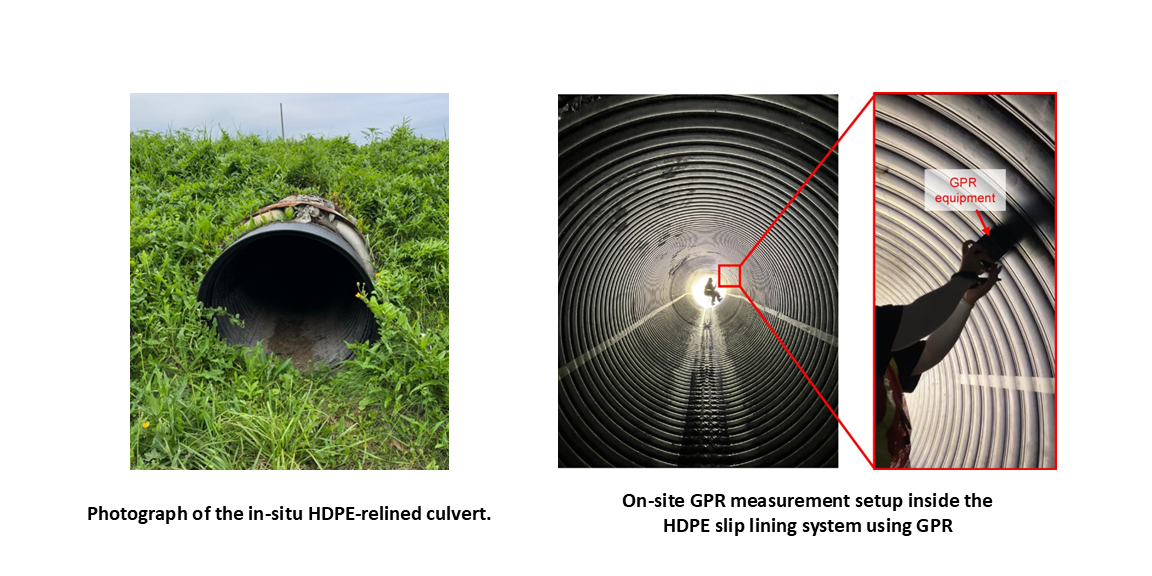
High-Frequency GPR for Culvert Grout Inspection (TUST 2026)
On September 2026
Researcher: Jinyoung Hong, Ngoc Quy Hoang
Description: We evaluate high-frequency ground-penetrating radar (GPR), operating at frequencies up to 6 GHz, to detect grout voids in HDPE-lined steel culverts. The method identifies concealed defects by analyzing amplitude reductions and phase changes in radar reflections. Numerical simulations, laboratory experiments, and field tests at two culvert sites validated the approach. Voids detected during field inspections were independently confirmed through endoscopic inspections, supporting its application to rehabilitation quality control and culvert condition assessment.
Citation: Jinyoung Hong*, Hajin Choi, Chul Min Yeum, Giovanni Cascante, Ngoc Quy Hoang*, Su-Min Kang, and Tony Sangiuliano, “High-Frequency Radar Evaluation of Grouting Integrity in HDPE-Lined Steel Culverts,” Tunnelling and Underground Space Technology, 175, 107827 (2026).
Concrete Surface Roughness Assessment with Smartphone LiDAR (NDT&E 2024)
On July 2024
Researcher: Rishabh Bajaj, Wilson Carofilis
Description: Concrete surface roughness is critical to interface shear resistance between concrete cast at different times, affecting structural safety at construction joints. Traditional roughness evaluation relies on subjective visual comparison methods. We introduce a quantitative approach using smartphone LiDAR to measure surface roughness from 3D point clouds. Laboratory validation and multi-site field testing show strong agreement with structured-light ground truth measurements, demonstrating a reliable and practical field solution.
Citation: Rishabh Bajaj*, Wilson Carofilis*, Chul Min Yeum, Trevor D. Hrynyk, Maria Anna Polak, Martin Krall, “Rapid Concrete Surface Roughness Assessment with Smartphone LiDAR,” Nondestructive Testing and Evaluation (2024): 1–21.
Acceleration-Based Automated Vehicle Classification (CACAIE 2016)
On June 2016
Researcher: Chul Min Yeum
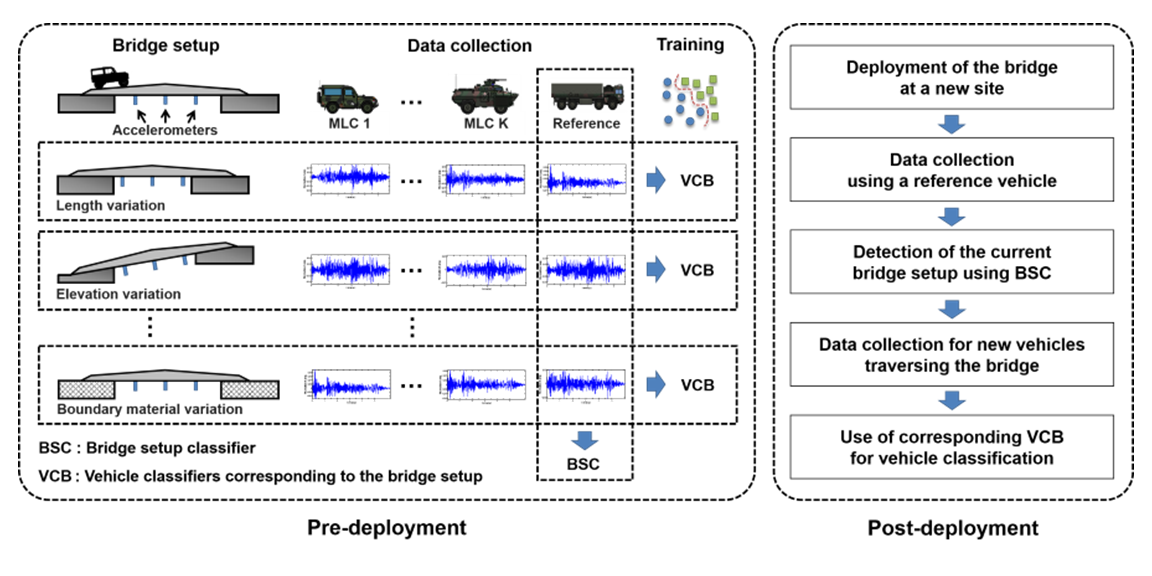
Description: Mobile bridges are deployed rapidly under diverse and irregular loading conditions, making usage tracking critical for safety. We propose an acceleration-based vehicle classification method that identifies vehicle classes using distinctive dynamic signatures extracted from acceleration responses. Signals are converted to time–frequency images and classified using a Viola–Jones detector. The method is validated through laboratory and full-scale bridge tests.
Citation: Chul Min Yeum, Shirley J. Dyke, Ricardo E. Basora Rovira, Christian Silva, and Jeff Demo, “Acceleration-Based Automated Vehicle Classification on Mobile Bridges,” Computer-Aided Civil and Infrastructure Engineering 31(11), 813–825 (2016).
Project page: Github
Reference-Free Delamination Detection Using Lamb Waves (SCHM 2014)
On August 2013
Researcher: Chul Min Yeum
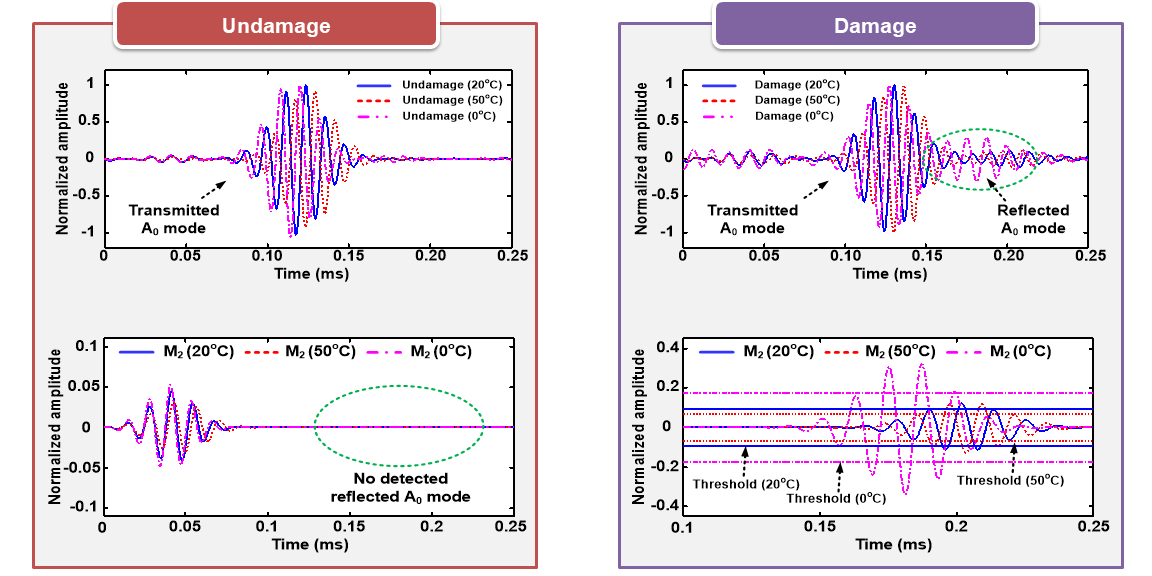
Description: A Lamb-wave-based technique detects delamination using a single propagation path without baseline data. Dual PZTs excite and sense waves, enabling extraction of reflected A0 modes hrough mode decomposition and matching pursuit. The approach forms a reference-free classifier capable of robust damage detection even under varying temperatures.
Citation: Chul Min Yeum, Hoon Sohn, Hyung Jin Lim, and Jeong Beom Ihn, “Reference-Free Delamination Detection Using Lamb Waves,” Structural Control and Health Monitoring 21(5), 675–684 (2014).
Project page: Github
Instantaneous Delamination Detection in a Composite Plate (Composite Structures 2012)
On December 2012
Researcher: Chul Min Yeum
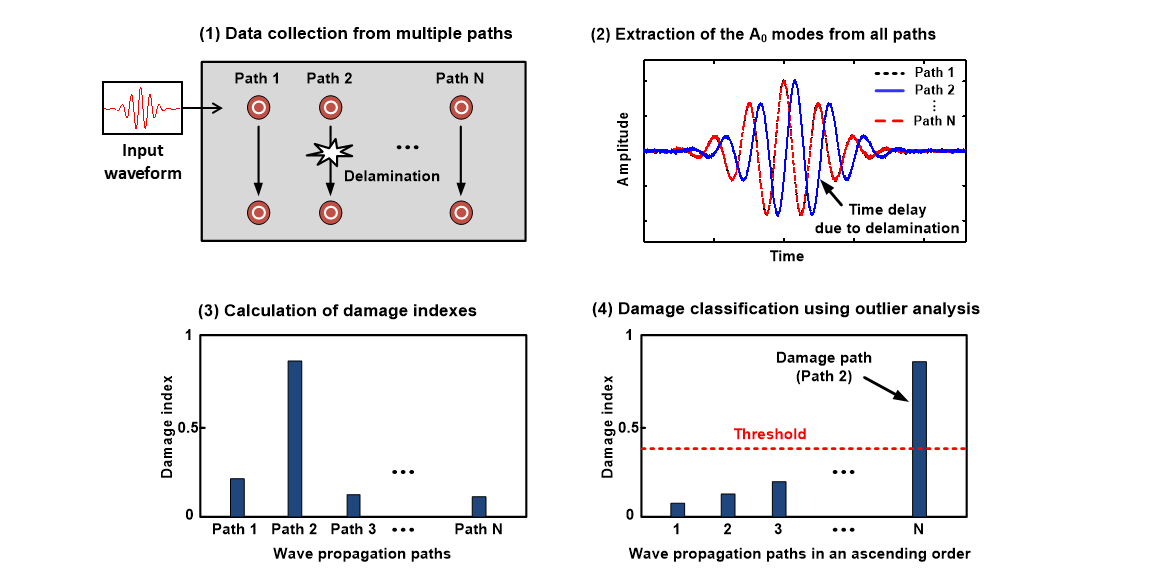
Description: A baseline-free Lamb-wave method detects delamination in composite plates using a dual-PZT network. The approach isolates the A0 mode and uses relative time delays across paths as damage-sensitive features. Instantaneous comparisons enable robust detection without baseline signals, even under temperature variation.
Citation: Chul Min Yeum, Hoon Sohn, Jeong Beom Ihn, and Hyung Jin Lim, “Instantaneous Delamination Detection in a Composite Plate Using a Dual Piezoelectric Transducer Network,” Composite Structures 94(12), 3490–3499 (2012).
Lamb Wave Mode Decomposition Technique (Wave Motion 2011)
On June 2011
Researcher: Chul Min Yeum
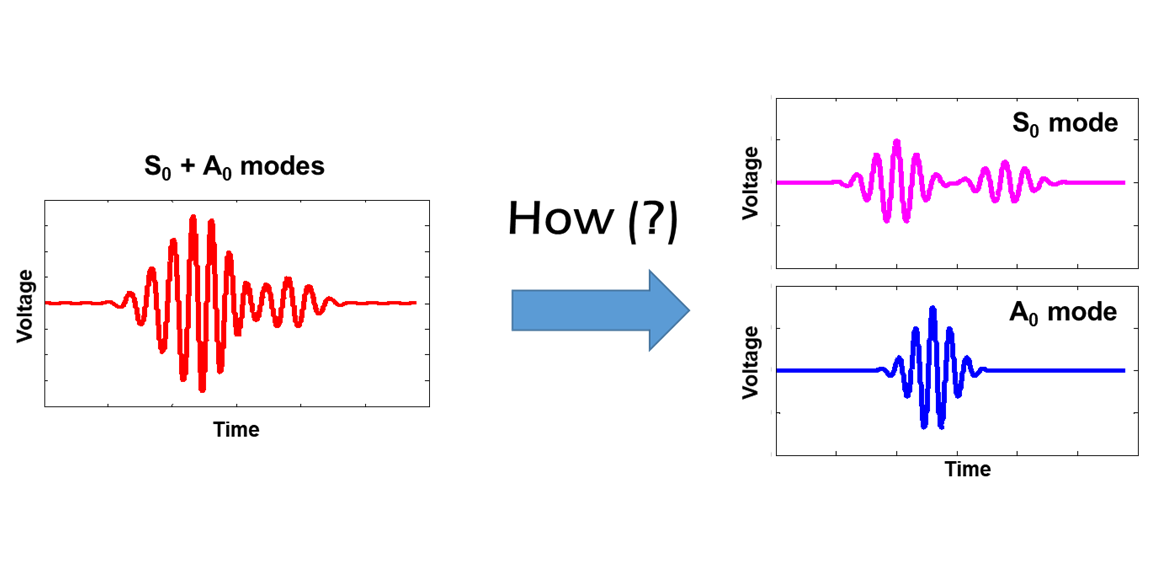
Description: We propose a Lamb-wave mode decomposition technique using concentric ring and circular PZTs. By solving 3D propagation equations while considering transducer geometry, the method separates wave modes effectively. Numerical simulations and experiments on aluminum plates validate accurate decomposition and improved signal interpretation.
Citation: Chul Min Yeum, Hoon Sohn, and Jeong Beom Ihn, “Lamb Wave Mode Decomposition Using Concentric Ring and Circular Piezoelectric Transducers,” Wave Motion 48(4), 358–370 (2011).
Project page: Github